"Blonde Woman with Bare Breasts" (1878) by Édouard Manet
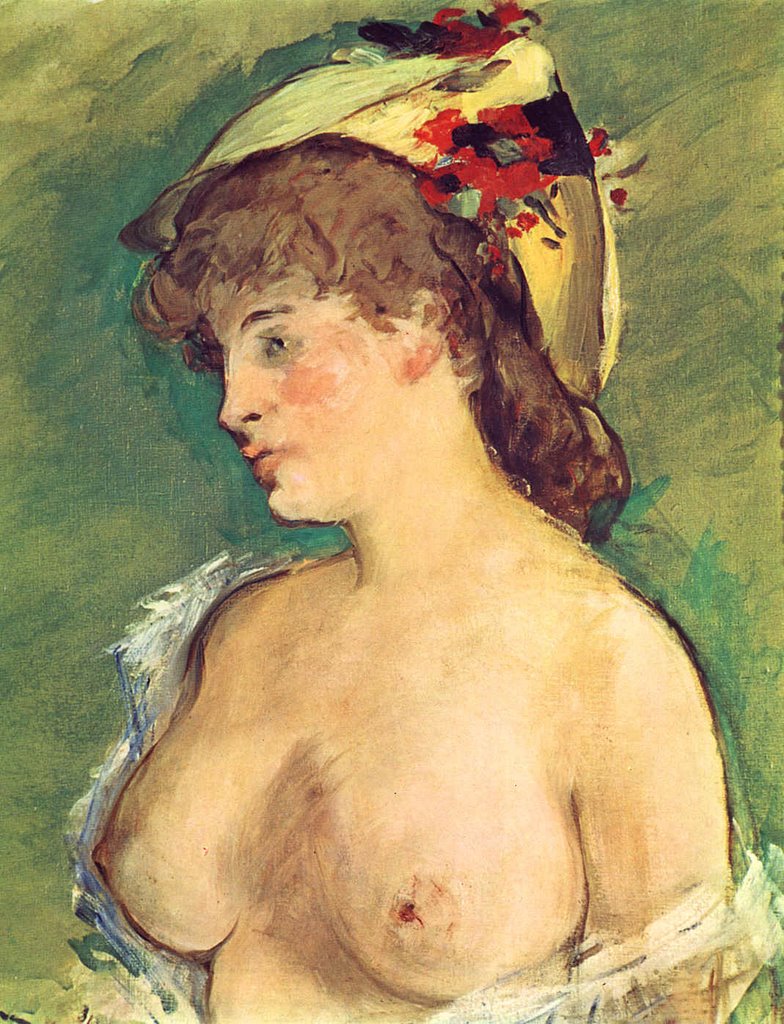
Édouard Manet, Blonde Woman with Bare Breasts (1878), Oil on canvas, Musée d’Orsay, Paris, France


Édouard Manet, Blonde Woman with Bare Breasts (1878), Oil on canvas, Musée d’Orsay, Paris, France


Rail Post with a Yakshi, India, Mathura region, Red sandstone, Kushan period, 2nd c. AD (source)

Yakshinis (also called yaksinis or yaksis) are benevolent mythical beings of Hindu, Buddhist, and Jain mythology. A yakshini is the female counterpart of the male yaksha, and they both attend on Kubera (also called Kuber), the Hindu god of wealth who rules in the mythical Himalayan kingdom of Alaka. They both look after treasure hidden in the earth and resemble that of fairies. Yakshinis are often depicted as beautiful and voluptuous, having large curves and wide hips. In the Uddamareshvara Tantra, thirty-six yakshinis are described, including their mantras and ritual prescriptions. A similar list of yakshas and yakshinis is given in the Tantraraja Tantra, where it says that these beings are givers of whatever is desired. (source)
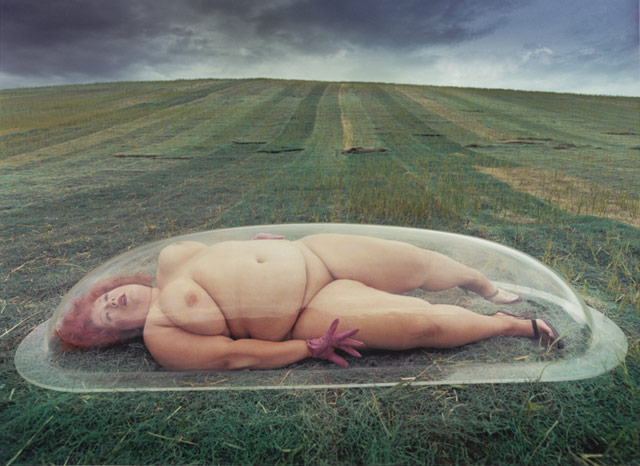 David LaChapelle, The Lonely Doll I, Sharon Gault, i-D, New York 1998
"Well, there’s a lot of different statements going on, I mean, there’s celebrity images, pictures of some of the most famous people that make up our world. Madonna, Elton John. There’s also the most obscure people, people that are marginal, like Sharon Gault, who’s a very large woman and looks like a gigantic doll. I did her as a lonely doll on a hillside (Gault was the make-up artist Madonna giggled at in the In Bed with Madonna movie after she told her, 'I woke up and my butt was bleeding')." (link)
"In 'The Lonely Doll,' a chubby nude woman lies under a plastic dome in a vast plowed field. Something is terribly wrong with her right hand." (link)
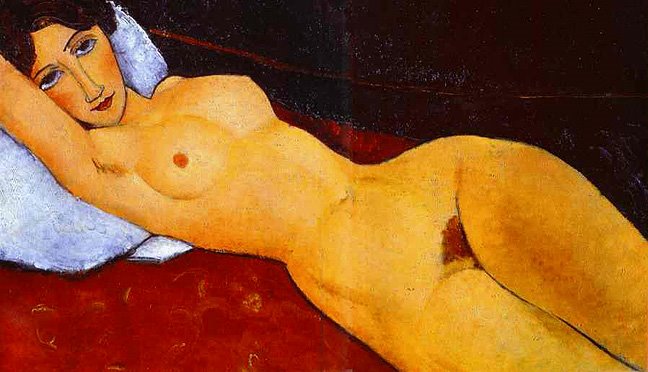 Reclining Nude (1917)
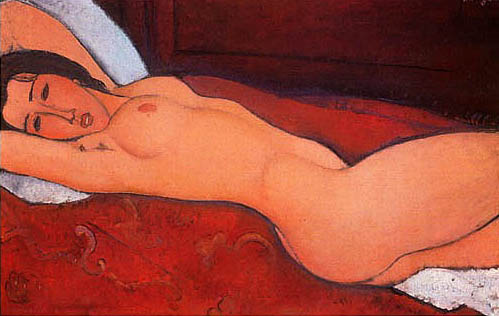 Red Nude (1917)
 Seated Nude (1917)
 The Big Nude (1918)
 Reclining Nude (1919)
From his Wikipedia article:
"Aged 16 he made his first sexual conquest with a young Norwegian tourist and embarked on a path of debauchery from which he would never deviate."
"Modigliani had a turbulent 35 year existence, he battled childhood illness and family depression, seduced a phalanx of models and artists and fathered at least three children before the drugs and alcohol which fired his creativity ultimately ended his life in a squalid, untidy flat."
 Russ Meyer, Lorna on green cushion (1964/2002)
C-print (custom color print Fuji crystal dyecoupler), 20 x 16 inches unframed, edition of 20
Russ Meyer, Lorna on green cushion (1964/2002)
C-print (custom color print Fuji crystal dyecoupler), 20 x 16 inches unframed, edition of 20
 Russ Meyer, Lorna and gold lamp, 1964/2002
C-print (custom color print Fuji crystal dyecoupler), 14 x 11 inches unframed
Russ Meyer, Lorna and gold lamp, 1964/2002
C-print (custom color print Fuji crystal dyecoupler), 14 x 11 inches unframed
"I like women who are epically built, bounteous, super-abundant; who have humongous, conical, sleek, blue-veined giganzos accessorized by protuberant nipples surrounded by aureoles double the circumference of a silver dollar! Bosom Maximus!" These are the criteria Russ Meyer, now 80, and the closest thing America has produced to Rabelais, says he will use to cast an upcoming movie to be called either The Bra of God or Beyond the Valley of Pulp a Go-Go. [..] Variously dubbed "King Leer," "Hollywood primitive," "trash master" and "dirty old man," this self-proclaimed "King of the Nudies" and "glandscape artist" not only defined the sexploitation genre, he practically invented it.
[..]
In 1959 he made The Immoral Mr. Teas, the story of a man who can see through women's clothing. Shot in four days for $24,000, the film grossed more than a million. Since then, Meyer has directed 23 films -- most of them moneymakers -- and become a legend. His 1965 classic, Faster, Pussycat! Kill! Kill!, the story of three go-go dancers who set off on a killing spree, was deemed "the worst film ever made" by the San Francisco Chronicle. John Waters, on the other hand, asserts it's "beyond a doubt, the best movie ever made. . . . possibly better than any film that will ever be made in the future." Best or worst, Meyer, who lives in Hollywood Hills, is currently having his first New York gallery show. The exhibition, a display of 21 black-and-white and color photographs -- some of them stills from movie productions, most studio shots -- is a batty mix of cheesiness, camp, chasteness ("I don't consider what I do pornography. I call it 'tittie boo' ") and over-the-top (and I do mean top) voluptuousness. "I start to get interested at about a D cup," Meyer has said. "Anything smaller than that is just too small for me. It doesn't matter to me if the boobs are real or fake as long as they're huge."
(from the Village Voice article "Bosom Maximus - "Russ Meyer" Feigen Contemporary" by Jerry Saltz, June 3rd, 2002)Erwin Olaf lives and works in The Netherlands and enjoys a major reputation in Europe with more than a dozen museum and gallery exhibitions scheduled for the near future in his native country and Russia, Poland, Spain and Denmark. His work is represented in the Stedelijk Museum Amsterdam, The Groninger Museum, Groningen, The Gemeentemueum Den Haag and the ABN AMRO Collection among others. "Perverse Elegance", a major retrospective will travel in Australia in 2006. He is directing and producing a new film titled "Captain Tom". His most recent retrospective book is Silver (2003).


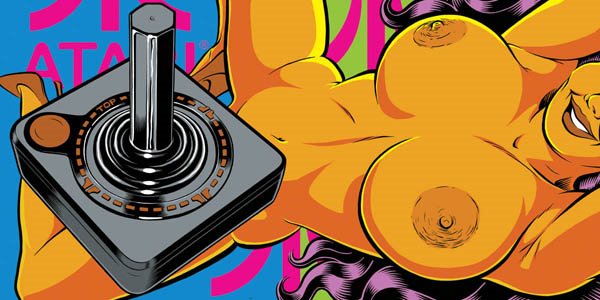 "Atari" (2006) by Coop, Acrylic on canvas, 122 x 72 in. Courtesy sixspace gallery.
This painting is from Coop's solo exhibition Brand Recognition where he presents new acrylic-on-canvas paintings and ink-on-paper works. Continuing his exploration of re-appropriation, Coop expands on dissecting his own iconic imagery, popular culture, and art historical references with his new series of bold, sexy, and smart paintings.
Brand Recognition deals with the prevalence of corporate logos in contemporary society and how they have integrated seamlessly into our culture. Being both fascinated and repelled by the ubiquity of these logos, Coop addresses how they have moved passed being simple eye-catching advertisements and how they have become a part of how we self-identify in society. Combining these easily recognizable corporate images with his own popular brand, Coop touches upon the duality of himself becoming complicit in the very subject that he often finds so troubling.
Coop came out to Los Angeles from Bixby, Oklahoma in the late 1980s and quickly became regarded as one of the preeminent underground artists of his time - his iconic imagery of devil girls, smoking devil, and cars has solidified his place in pop-culture history. Exhibitions of his work have been held in galleries and museums in Los Angeles, London, New York, Chicago, and Zurich, Switzerland. His most recent solo exhibition, Parts with Appeal at sixspace in 2004, contained an ambitious continuous 78-foot multi-panel painting depicting fragmented and re-constructed images of the iconic figures he has created. Publications featuring Coop’s work have included Artweek, Juxtapoz, Paper Magazine, Playboy, The Los Angeles Alternative Press, and Rodders Journal. 2001 saw the publication of his first book - "Devil's Advocate: the Art of Coop" - and his popular sketchbook "The Big Fat One” was released in 2004.

This blog has moved to
artboobs.tumblr.com
All photos are courtesy and copyright of the artists, and link to (mostly) larger versions. Comments are appreciated (and can be anonymous). Please e-mail tips, praise and suggestions to artboobs@gmail.com.