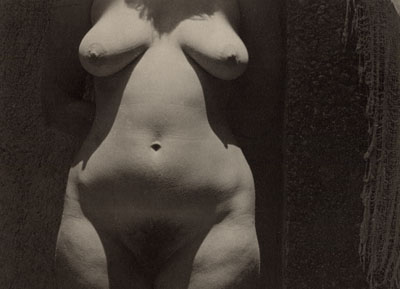
"311-11" by Viktor Ivanovski
 Viktor Ivanovski, 311-11, photograph
The rest of Ivanovski's work we've seen is pretty run-of-the-mill 'erotic nudes' photography, but this photo we had to share with you.
Viktor Ivanovski, 311-11, photograph
The rest of Ivanovski's work we've seen is pretty run-of-the-mill 'erotic nudes' photography, but this photo we had to share with you.
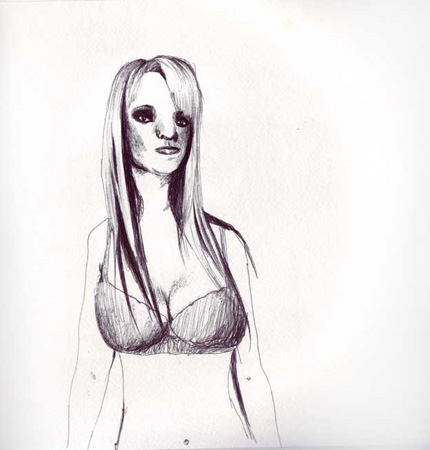 Erica Eyres, Untitled, Ballpoint pen on paper, 43 by 64 cm, 2005
Erica Eyres (Canada, 1980) completed her BFA at the University of Manitoba in Sculpture in 2002. In 2004 she finished her MFA at the Glasgow School of Art. (source)
Eyres speaking about her drawings:
Most recently I have been working on a series of drawings that focus on women and how they portray themselves through self-portraits, and how these images reflect their sexuality and their self-esteem. These women straddle the border between being pitiful and hilarious so that they demand both empathy and uncomfortable laughter.
The drawings are inspired by men’s magazines, with photo spreads such as "Real Girls to Phone and Date". Women are encouraged to submit photos of themselves and to describe their ideal man, or why they’ll "do anything". I am interested in the low production quality of these images (some taken with mobile phone cameras), and how they become self-portraits that reveal the women’s insecurities and clumsiness. The original context is removed from the drawings, depicting young women who pose awkwardly in their underwear, displaying deformities that could be either major or minor (depending on how we choose to see them). Despite their awkwardness, however, the women stare back at the viewer with a kind of ease, rather than a resignation. They appear eager or expectant, implying that they are awaiting the viewer’s approval. The viewer becomes uncomfortable, not sure if they should find the women attractive, ugly, melancholy, or threatening.
Flor Garduño was born in Mexico City in 1957 and in 1979 became darkroom assistant to Manuel Alvarez Bravo. She developed her own style while working under photographer Mariana Yampolsky at the Secretary of Public Education, which involved her in visiting the rural areas of Mexico. Since then she has become an internationally acclaimed photographer, and now divides her time between Mexico and Switzerland.


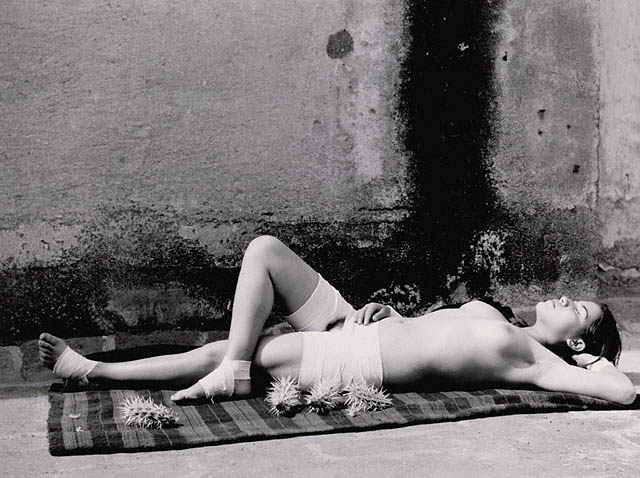
Whether concealed by a fig leaf or locked by a chastity belt, a woman's erogenous area has traditionally been kept hidden from view. Flouting convention, Manuel Alvarez Bravo staged this scene by clothing the model's upper thighs, hips, and waist, and exposing her pubic region. Although this photograph challenges traditional representations of women, it alludes to confinement through the use of bandages around the model's wrists and ankles. These devices can be interpreted as symbols of bondage and lack of free will.
In this seemingly serene setting, the star cacti lined up beside the slumbering model signal pain and danger. The plants impede the woman's free movement, while at the same time protecting her from the sexual advances of a potential intruder. In naming this photograph The Good Reputation, Sleeping, Alvarez Bravo drew upon the Mexican proverb: Earn a good reputation, then rest on your laurels. (source)
A self-taught photographer, Manuel Alvarez Bravo (1902-2002) purchased his first camera at age twenty while working at a government job. His earliest success at photography came around 1925, when he won first prize in a local photographic competition in Oaxaca. He returned to Mexico City, where he had been born, and in 1927 met Tina Modotti, who introduced him to a lively intellectual and cultural environment of other artists from various disciplines. Among them was Edward Weston, who encouraged Alvarez Bravo to continue photographing; Weston wrote to him in 1929: "Photography is fortunate in having someone with your viewpoint. It is not often I am stimulated to enthusiasm over a group of photographs." (source)


Lola Alvarez Bravo (1907-1993) was Mexico's first woman photographer. Her work is exceptional for both its compelling quality and its startling diversity. She began making photographs in 1926 under the tutelage of her husband, Manuel Alvarez Bravo, and continued photographing for the next sixty years. Although some of her earliest photographs reflect her husband's influence - they shared the same simple Kodak, and often the same role of film - Lola achieved her own aesthetic during the 1940s and '50s, concentrating on two particularly vivid bodies of work-portraiture and street photography. (source)

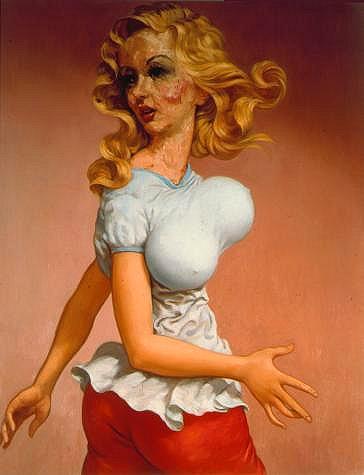 Twisting Girl, 1996, oil on canvas, 96.5cm x 76cm
 The Bra Shop, 1997, oil on canvas, 48 x 38 in.
 Dogwood, 1997
 La vieille barrière, 1999, huile sur toile, 193 x 102 cm
 The Wizard, circa 1994
There are some wildly different ideas about exactly what Currin is up to—New York Times critic Michael Kimmelman sees him as "a latter-day Jeff Koons" trafficking in postmodern irony while Peter Schjeldahl at The New Yorker finds him a blissfully sincere artist tapping into the timeless values of "mystery, sublimity, transcendence." But everyone is unanimous about one thing: John Currin can paint. (source)
[..] A few years later he presented an instantly notorious group of paintings of women with basketball-sized breasts and faces done in craggy impasto acting out various soft-porn scenarios. Crass jokes rendered in oil on canvas, they are ostentatiously "bad paintings" done in the defiantly ironic mode of high-concept kitsch. Though the reviews were tepid, Currin got a big thumbs-up from Juggs magazine, which applauded him for "paying attention to the worthy theme of big tits." (source)


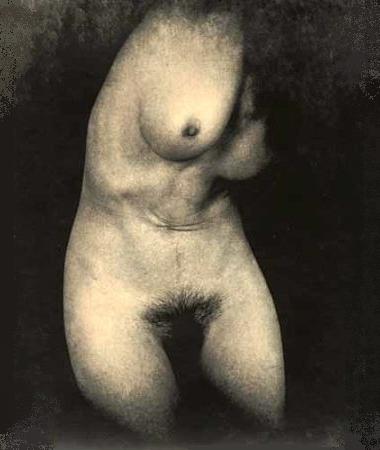 "Twisted torso"
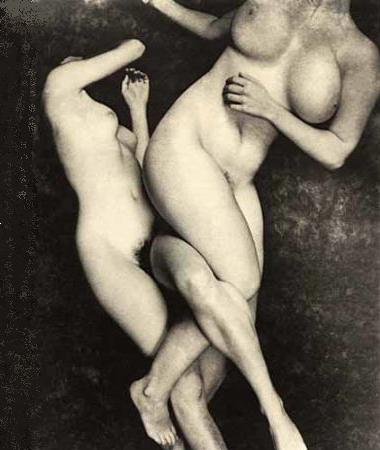 "Entwined" (1987), Toned gelatin silver print from manipulated paper negative
 "Primitive Dance", 2004, gelatin silver print, chemically altered, 15 1/2" x 19 1/2"
Robert Asman is a craftsman, educator, and artist. He has taught at Drexel University, University of the Arts, and presently teaches at the University of Pennsylvania. As an artist he received a BA from Catholic University and an MFA from Rochester Institute of Technology. He is and has been actively engaged in making and exhibiting his works in galleries and museums around the world, but primarily in Philadelphia where he maintains his residence and studio.
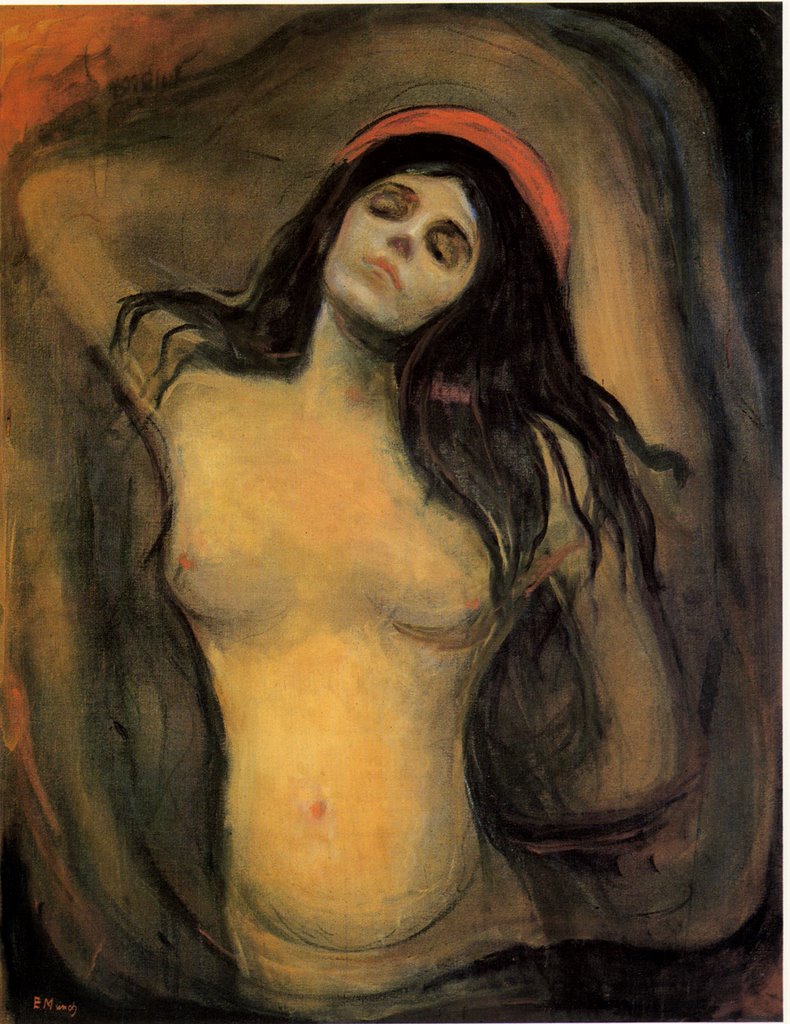 Edvard Munch, Madonna (1894-1895)
The title "Madonna" suggests a depiction of Mary, the mother of Jesus, although it is a highly unusual representation of Mary, who until the 20th century was usually represented in high art as a chaste, mature woman. The figure in this painting appears to be young, perhaps a teenager, and is sensualized, if not eroticized, by her twisting, expressive pose. She stretches her arms behind herself and arches her back, increasing the viewer's consciousness of her physical body. Yet even in this unusual pose, she embodies some of the key elements of canonical representations of the Virgin: she has a quietness and a calm confidence about her. Her eyes are closed, expressing modesty, but she is simultaneously lit from above; her body is seen, in fact, twisting toward the light so as to catch more of it, even while she does not face it with her eyes. These elements suggest aspects of conventional representations of the Annunciation. (source)
From today's news:
Two years after the Edvard Munch masterpieces The Scream and Madonna were stolen from the Munch Museum, Oslo Police recovered the two masterpieces in a bold daylight raid, according to the authorities. The works are in a much better than expected condition, announced the police in a press conference. Police stated that they think the works were in Norway all the time, although they did not reveal where they found the works. According to Iver Stensrud, head of the Oslo Police District's organized crime division, no ransom nor reward was paid.
The works were stolen from the Munch Museum on August 22, 2004. So far, no arrests have been made. "The Scream" is valued at around $81 million and "Madonna" at $100 million.
Gro Balas, director of culture for the city of Oslo, said, "I am, on behalf of Oslo's entire population, both relieved and happy." She later said the paintings are owned "by everyone," and that "the whole world has an option on these paintings."
Ingebjørg Ydstie, acting leader of the Munch Museum in Oslo, stated "I feel a great sense of joy on behalf of the museum and a whole world of art lovers. This is a big day."

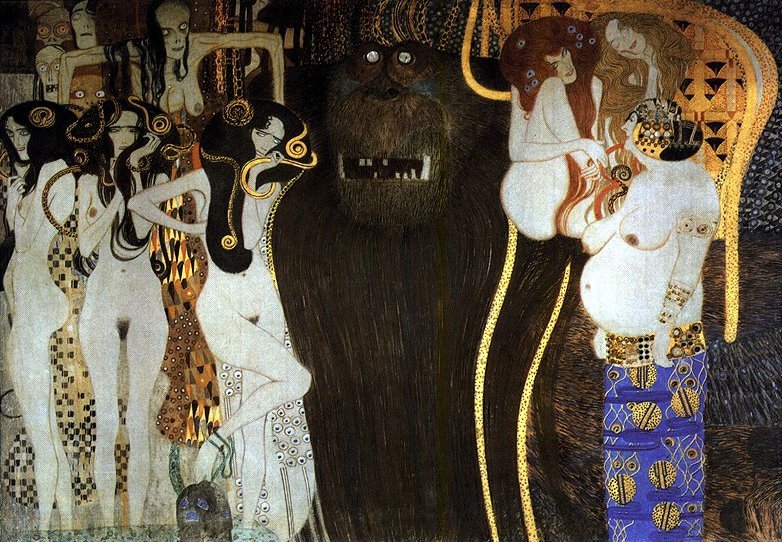
Gustav Klimt (1862–1918) was an Austrian Symbolist painter and one of the most prominent members of the Vienna Art Nouveau movement. His major works include paintings, murals, sketches and other art objects, many of which are on display in the Vienna Secession gallery. Klimt's primary subject is the female body, and his works are marked by a frank eroticism. (source)


This blog has moved to
artboobs.tumblr.com
All photos are courtesy and copyright of the artists, and link to (mostly) larger versions. Comments are appreciated (and can be anonymous). Please e-mail tips, praise and suggestions to artboobs@gmail.com.