Showing posts with label australia. Show all posts

Monday, August 27, 2007

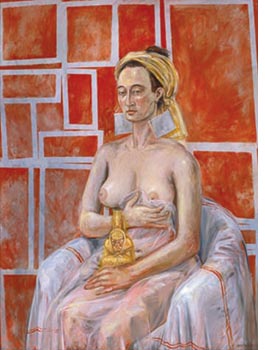
"Odalisque" (2007) by Anwen Keeling

"Odalisque" (2007) by Anwen Keeling, oil on linen, 122 x 81cm. From "the falling dark" series.

An odalisque was a virgin female slave who could rise in status to be a concubine or a wife in Ottoman Seraglios. Most were part of the harem of the Turkish sultan. See also previous posts featuring odalisques.

Here's some ArtSpeak™, courtesy of Elizabeth Hastings, Liverpool Street Gallery:

Keeling’s beguiling, realist paintings capture suspended moments in fictional lives with a reverence for drama, suspense and elegance. Like film stills from an Alfred Hitchcock thriller, Keeling’s isolated female figures are placed in a series of interiors where the space is either suffused with subtle, refracted light or illuminated by the harsh glare of an electric bulb. A film noir ambience is achieved with chiaroscuro effects and deep shadows which suggest an emotional and psychological undercurrent to the work. Yet the viewer is left to create their own narrative.

Here's a very nice photo of the artist herself:

Monday, September 18, 2006

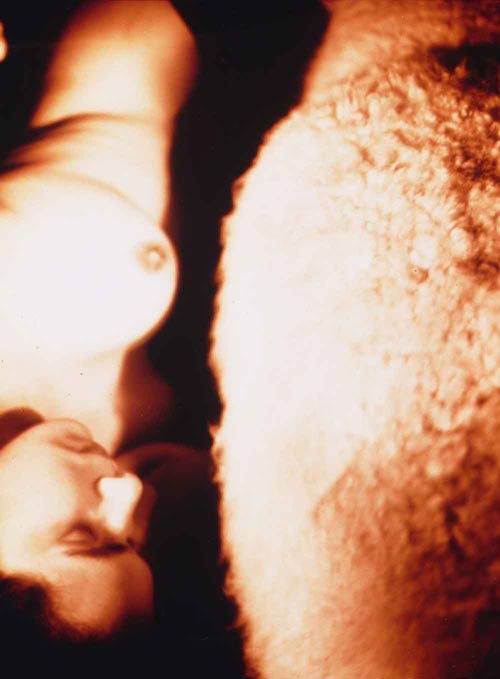
"Pet Thang" (1991) by Tracey Moffatt

"Pet Thang #4" (1991) by Tracey Moffatt, #4 from a series of 6 images, photograph, 110 × 71cm, Edition of 30

Tracey Moffatt (1960) is an Australian artist who primarily uses photography and video. Her work is held in various international private and public collections including MOMA (NYC), Tate Modern (London) and Museum of Contemporary Art (Los Angeles).

Tracey Moffatt first came to prominence in the Australian art world with her series Something More. First exhibited at the Australian Centre for Photography in 1989, the series set the tone and themes of much of her latter work. In a sequence of nine images, Something More is a loose narrative in which the artist puns on the possible meanings of the title and its veiled references to sadomasochism.

Moffatt's photographic series of works such as Pet Thang [1991] and Laudanum [1998] returned to the themes of Something More exploring mixed and sometimes obscure references to issues of sexuality, history, representation and race. Other series of images, notably Scarred for Life [1994] and Scarred for Life II [1999] again tackled these themes but which took the form of book or magazine illustrations with captions offering ironic and humorous commentaries on the images.

(sources: text | photos)

Wednesday, August 30, 2006

Work by Juan Davila (update)

Juan Davila, “Guacolda del Carmen Gallardo” (2004), oil on canvas, 120 x 90 cm, Courtesy of the artist, © the artist

Reference photography by Richard Francis for Chilean artist Juan Davila (pictured at right), including Spiderwoman (left) and a series of paintings relating to Australian bushranger Ned Kelly (centre).

Juan Davila is one of the most innovative and influential painters to have worked in Australia over the past thirty years. Arriving in Australia from Chile in 1974, his consistent interrogation of cultural, sexual and social identities has resulted in a rich, complex and provocative body of work. A firm believer in the political role of the artist, Davila’s paintings have critiqued directly the Australian political system, the cultural aspects of late capitalism, the structures of the art world and the hegemony of Western art history, the representation of sexuality, and more recently, the treatment of refugees in Australian detention centres. (source)

Here's a somewhat different perspective from "The worst art show ever" by Richard Dorment ("Richard Dorment searches desperately for signs of artistic talent at the 12th 'Documenta' show in Kassel, Germany"):

And that brings me to the question of taste. I couldn't believe my eyes when I saw how many works there are on show by the Chilean-born Australian painter Juan Davila, an artist whose high-camp imagery is best characterised as pornographic folk art. His heavy-handed satire is what you'd expect in the work of a political cartoonist, only Davila is a crude draughtsman, uses a paintbrush as though it were a sledgehammer, and isn't remotely funny. Until this show, I didn't think it possible that his work could receive attention outside Australia. (source)