Showing posts with label germany. Show all posts

Wednesday, February 20, 2008

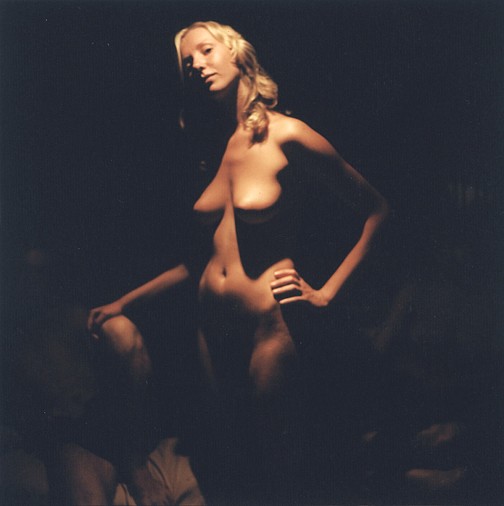
"gr 20" (2003) by Thomas Ruff

"gr 20" (2003) by Thomas Ruff. Chromogenic color print mounted with Diasec face in artist’s wooden frame. This work is from an edition of five plus two artist’s proofs. Estimate: $50,000-70,000

From an auction. Previous post on Ruff.

Thursday, November 15, 2007

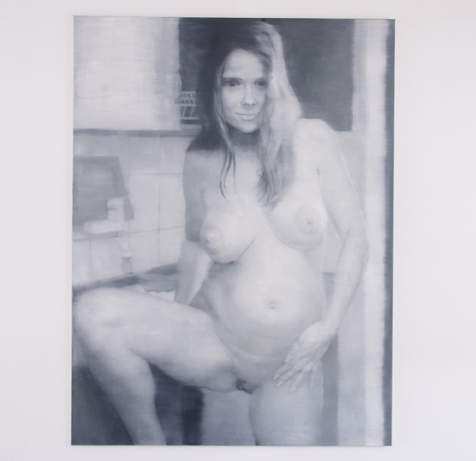
"Alina" (2007) by Frank Bauer

Frank Bauer, Alina, oil on canvas, 2007, 80 x 60 cm Courtesy Galerie Voss Düsseldorf

From November 30th on, Galerie Voss will show new works by Frank Bauer (Germany, 1964), master student under Gerhard Richter. Among the well-known photo-realistic works - paintings, that are always based on self-made photographs - the gallery will for the first time show a series of portraits, the title of the show refers to the models that have been posing for the artist. (source)

Tuesday, November 13, 2007

Two works by George Grosz

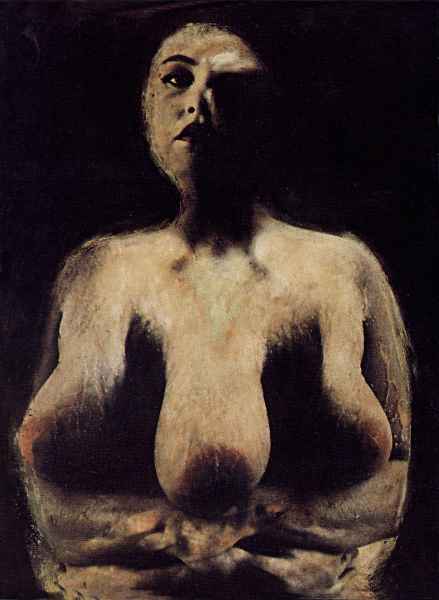
"Standing Nude" (1943) by George Grosz (1893-1959). Charcoal on paper. From an auction.

"Standing Nude" (1943) by George Grosz (1893-1959). Oil on paper. From an auction.

George Grosz (July 26, 1893 – July 6, 1959) was a prominent member of the Berlin Dada and New Objectivity group, known especially for his savagely caricatural drawings of Berlin life in the 1920s.

Friday, May 11, 2007

Three photos by Andrej Glusgold

"Das Phänomen der Exstase", 20x20cm, Ed. 15 / 37x37cm. Ed. 7

"Odalisque", 20x20cm, Ed. 15 / 37x37cm. Ed. 7

"Untitled", 20x20cm, Ed. 15 / 37x37cm. Ed. 7

Andrej Glusgold (Kishinev, Moldova, 1968) lives and works in Berlin. Besides photography he also draws and has published poetry.

Wednesday, May 09, 2007

Zwei Spanische Akte (Osterakte)" (1967) by Gerhard Richter

"Zwei Spanische Akte (Osterakte)" (1967) by Gerhard Richter. 139.7 x 148 cm. From an auction (estimated at 9,000,000—12,000,000 USD).

From the catalogue:

Gerhard Richter is recognised as one of the foremost painters of his generation. In a career devoted to exploring the potential and diversity of his chosen medium, Richter has single-handedly suspended the conventional opposition between figurative and abstract modes to express the manifold possibilities of painting to convey how we perceive the world. In the Photopaintings of the 1960s, such as the remarkable Zwei Spanische Akte (Osterakte), Richter engaged explicitly with issues of perception and illusion in art, challenging the representational nature of painting. He intended the subject of the work to be the photo as an objective representation, so the work becomes a human painterly reproduction of a mechanically reproduced image of a human moment in time. The lush sophistication of Richter's liquid paint strokes, the careful modulation of tonality and the blurring of the reproduced image all highlight the artificial role of the object as art and the maker as artist.

Influenced by American Pop art, Richter formed Capitalist Realists in 1963 with Sigmar Polke and Konrad Lueg, dedicated to the objective depiction of consumerism in an increasingly bourgeois Germany. Richter's use of photographs connected him to American artists such as Andy Warhol: both chose anonymous subjects to eschew traditional painterly concerns such as color, style and composition. For Richter, "the photograph is the most perfect picture" in its negation of aesthetic pretensions. Its role is to record factual information and not, as in the case of art, to apprehend the nature of an object and try to convey that nature through the subjectivity of the artist. The art of the 1960s was to a great extent defined by its reaction to the emphasis on originality and the artist's psyche-laden content of the 1950s, and Richter was not alone in seeking a means to strip away the recent past and examine the nature of painting. Just as Andy Warhol chose commercial products and Jasper Johns chose American flags, Richter's epiphany for a discourse on art was the photographic reproduction. As Richter commented: "There was no style, no composition, no judgement. It liberated me from personal experience. There was nothing but a pure picture. I wanted to process it and show it - not to use as a means for painting but to use painting as a means for the photograph." (interview with Rolf Schön in Exh. Cat., Venice, Biennale Internazionale dell'arte, Gerhard Richter, 1972, p. 23)

Zwei Spanische Akte (Osterakte) is an outstanding example of Richter's investigations of female images from 1966-1967. The female nude is one of art history's most sacred and recurring genres, appearing throughout time whether in the form of primitive fertility objects or the more recent masterful interpretations of Picasso and de Kooning in the 20th century. While Picasso and de Kooning chose the female form as a vehicle for expressive representation and abstraction, Richter takes on this loaded subject in service to his more neutralized, intellectual investigations. Richter culled his sources from newspapers, magazines and photographs - many found in Atlas, his ongoing survey of the photographic images he has used to stimulate his work since the early 1960s. As Atlas reveals, unlike Warhol, Richter selects his images not for any distinguishing characteristic or celebrity, but rather for their comprehensive ordinariness. However, that is not to say his selection was completely devoid of content or emotional references. Sex and death, fundamental themes at the universal heart of human existence, appear from the beginning and frequently thereafter whether in paintings of nudes or in the later still-lifes of skulls and candles.

In the 1966-1967 paintings of female nudes, Richter chose from sensational sources. The famous group work of Acht Lernschwestern (Eight Student Nurses), painted in 1966 and in the collection of Kustmuseum, Winterthur, is the most harrowing subject in this group as it is sourced from newspaper photographs of serial killer Richard Speck's victims, all brutalized and murdered in one night in the same Chicago townhouse. Other works focusing on female nudes, such as Zwei Spanische Akte (Osterakte), are derived from anonymous pornographic images. Yet in the process of using such loaded images, Richter's technique negates the factual nature of the source, highlighting the inability of photography - even the most immediate of mediums - to capture truth.

The infinite subtlety of tone and mark employed in Zwei Spanische Akte (Osterakte) emphasizes the illusion inherent to painting as the mesmerizing beauty of the two nudes emerges from an ethereal mist of brushwork. Yet, Richter's virtuosity with paint belies the choice to emphasize the photograph as subject matter. Richter's handling of oil paint here, deftly obscured to make the object appear like a fleeting, passing moment - or more precisely a blurred photograph - verges on the sublime but also distances the viewer from the photographic source. The blurring serves many purposes: firstly, it erases or obscures the content of the image, thereby forcing the viewer to step out of the narrative framework one expects to be informed by, and to enter a more abstract domain that focuses the eye on issues of perception and conception. By feathering the paint or dragging a hard edge through the wet, still-drying pigment, Richter's paint surface creates a wonderfully dynamic effect of an image being conjured or captured at greet speed, as if the scene had been fleetingly observed. The mimesis quality of picture-making - that is, to convey information on what an object is by what it looks like - is countered and obscured by the oscillating quality of Richter's paint surface.

As Sean Rainbird has noted, "Photography supplied pictures unconnected to [Richter] in their origination, possessed of their own intrinsic objectivity and free of connotation." (Exh. Cat., London, Tate Gallery, Gerhard Richter, 1992, p. 16) Photography's inherent element of chance and muted colour range appealed to the artist's aesthetic appreciation, and lent themselves easily to the softness and subtlety of his painting style. The mass reproduction of the medium subverted traditional notions of artistic creativity and originality, and Richter recognised its potential to liberate painting such as Zwei Spanische Akte (Osterakte) from representational obligations. It enabled the conditions he had been searching for in his painting: pictorial objectification, subversion of the conventional role of the artist-creator, and most importantly, the perception of the painting as an independent entity.

Monday, April 02, 2007

Three photos by Johannes Schwab

Johannes Schwab is a German photographer. He lives and works in Berlin.

(via)

Thursday, February 22, 2007

"Pin-up No.96 (Ariadne)" (2005) by Anton Henning

"Pin-up No.96 (Ariadne)" (2005) by Anton Henning, oil on canvas, 125.5 x 157 cm. Courtesy: Haunch of Venison. Copyright: Anton Henning, 2005

Anton Henning (German, born Berlin in 1964) is a painter whose diverse subjects and styles, from abstract to figurative, from pin-up girls to interiors are plundered knowingly from art history and popular culture. However, unlike Picabia to whom he has been compared, Henning’s diverse paintings are united by a delight in sensual pleasure, a passion for the tactile quality of paint, and a critical and subversive wit. [...] For example, in Pin-up No.96 (Ariadne), 2005 (pictured above) a sunbathing naked woman is overpainted on an abstract patterned background that can be read as a huge beach towel. However, Henning has given the work a black horizon, introducing an element of pure abstraction, and giving the total composition a sense of the surreal. This playful combination of disparate elements and styles helps to make seemingly familiar imagery strange and arresting.

(source)

Saturday, January 20, 2007

"Der frühe Vogel fängt den Wurm" by Martin Pudenz

"Der frühe Vogel fängt den Wurm" by Martin Pudenz (1948)

The title translates as "The early bird catches the worm".

via

Friday, January 19, 2007

"The Conquest of Happiness" (2005) by Oliver Pietsch

"The Conquest of Happiness" (2005) by Oliver Pietsch, Video, 45 min, Courtesy of Goff + Rosenthal, Berlin

Oliver Pietsch, an emerging video artist and filmmaker working in Berlin, demonstrates that in art and filmmaking there are no "final hits" - no conclusive imagery or idea in film that cannot be recycled, renewed and reinterpreted. Born in Munich in 1972, the artist lives and works in Berlin. He has received numerous awards for his work and has been in many group exhibitions across Europe.

Pietsch's film, The Conquest of Happiness, forty-five minutes long, took two years of research and editing to finish. It encompasses more than three hundred drug-related video clips taken from the history of film. It is organized according to the particular drug being addressed--heroin, cocaine, marijuana, etc--and set to a soundtrack devised by Pietsch. The soundtrack includes music by the Eggs, the Mooseheart Faithstellar Groove Band, Neil Young, F.S. Blumm, Neu, Pass into Silence, Pascal Schäfer, Spaceman 3, Roy Orbinson, John Carpenter, M.T. Fern, Brian Eno, and Daniel Lanois. Music is a key element of production for Pietsch, as he says it "has to work with the pictures, to hold all the different material together like glue and at the same time transport a certain feeling or point of view." Says Pietsch, "'The Conquest of Happiness' is equal parts documentation, experimental film and music clip. It is a compilation film about drug-use and its representation in movies."

There's a video of Cat Power's "Maybe Not" directed by Oliver Pietsch on YouTube.

Sources: text | image

Wednesday, January 10, 2007

Six works by Martin Eder

"Memoirs of My Nervous Illness" by Martin Eder, watercolour and graphite on paper
"Don't Trust Violence" (2003) by Martin Eder, 2003, Oil on canvas, 53 x 42 inches (framed), Rosette Delug Collection
"Dead Star / Black Hole / Shine On My Little Light / Big Pancake Peacefest" (2000) by Martin Eder, polystyrol, 7x8 m
"My sick eyes search for you" (2002) by Martin Eder, installation with 16 watercolours

Martin Eder (1968, Augsburg, Germany) lives in Berlin.

Don't be fooled by the initial cuteness of his paintings and watercolours. It's all about context, baby. His paintings, drawings, watercolours, videos and photography are often part of quite gothic installations and performances. The monumental "Dead Star [..]" sculpture above consists of a vast amount of polystyrene insulation boards, bought from your average DIY store and piled on top of each another, arranged in tiers, sawn, snapped, torn into shape, painted black and finally glued together.

Some small samples of his work can be seen through this page but most of the images above are taken from PDF catalogues found on this page. The "Don't Trust Violence" painting was found here.

Monday, December 04, 2006

"Nudes ama12" (2000) by Thomas Ruff

In his Nudes series, Thomas Ruff gathers from the internet erotic and often pornographic images which he subsequently manipulates by digitally enlarging, blurring, and coloring them. The results are beautiful photographs with an abstract and ethereal quality which seems to belie their erotic content. With Nudes ama12 (2000), which evokes art historical referents such as Courbet's The Origin of the World (1866), the viewer may be satisfied to linger upon the photograph's sumptuous surface quality, or they may accept Ruff's invitation to recreate the fantasy for themselves.

Homework assignment: Google for "ama12".

sources: image | text

Saturday, November 25, 2006

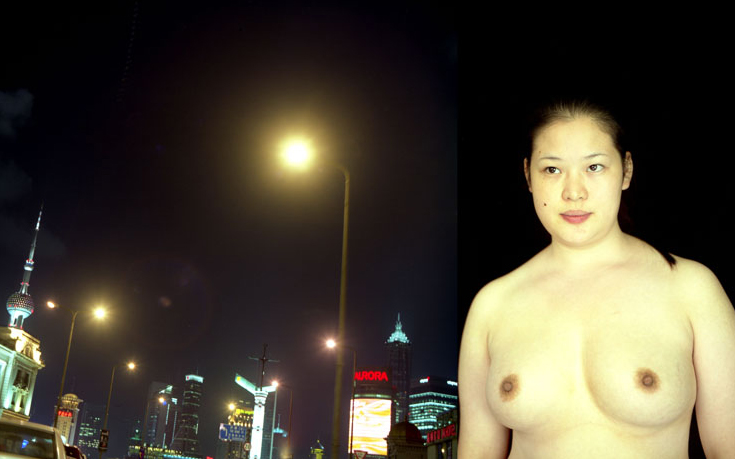
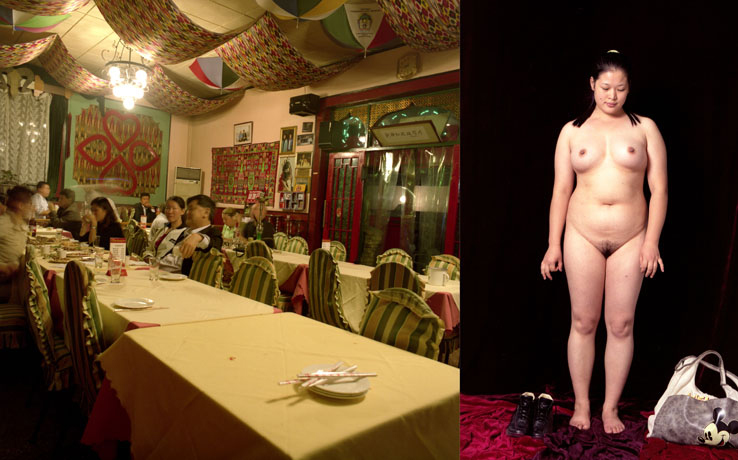
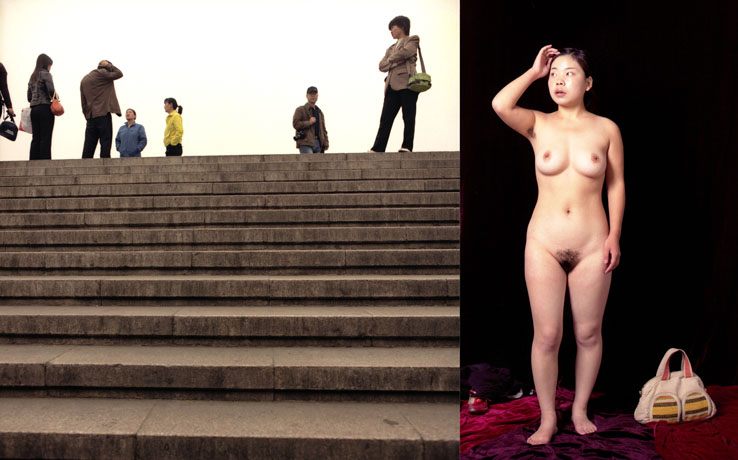
Three photos from "China Naked" by Frank Rothe

I love the way the girls' handbags and shoes are in the picture.

Frank Rothe: "For those that know my artist work they also know that I'm not the one who is interested in nude photography. But this work shows human beings naked and no erotic shots."

Over the last decade Frank Rothe (Germany, 1972) has been shooting and exhibiting internationally. He has worked on campaigns and as a staff photographer for international and national publications, including, Amica Italy, Stern, Die Zeit, Marie Claire USA, Esquire, Playboy, Guliver and many more. His work has been exhibited in Galeria Athos Bulcao Brazil, Goethe Institute Johannesburg in South Africa, Prague House of Photography in Czech Republic, Center of Contemporary Arts in the USA and other Galleries throughout the world and Germany.

Thursday, November 23, 2006

"Hell is Others (Richter)" by Roman Wolgin

Roman Wolgin (Moscow, 1978) lives and works in Berlin. His father was a Soviet State painter before becoming an Orthodox priest after the fall of the USSR. Roman graduated from the Rijksakademie in Amsterdam. He recently had solo exhibitions at Diana Stigter Galerie, Amsterdam and STORE, London,

Monday, November 20, 2006

"Mermaid" by Mona Kuhn

Beneath the calm relaxed surfaces of Mona Kuhn's (1969) photographs lies an explosive energy: the artist's controlled play with the power of sensuality. Kuhn does more than merely present the body to us viewers. The beauty and tension within her compositions and the flow of volume and focus planes, tempt the viewer, lure the eye and provoke the imagination. (source)

She'll have a new book out in 2007.

Friday, November 17, 2006

"Nicole, Großkugel" (1994) by Olaf Martens

The East German artist Olaf Martens (born 1963 in Halle, Germany) is interested in staging his pictures like a theatre play. In his often humorously constructed images, Martens combines a take on fashion, documentary, conceptual, social, and even animal photography and art historical and socio-political references. His work cannot be categorised but is a combination of what can be termed a kind of post-modern eclecticism.

Martens undermines the seemingly homogenous facade of the photographic. His works is characterised by uniting contrary details, and refiguring them in a very unique and hybrid manner. This leaves many questions to the viewer, not apparent on first glance.

Olaf Martens studied photography at the highly renowned Leipzig Academy for "Graphik und Buchkunst". His contemporaries are the well-known "Leipzig School" with artists such as Neo Rauch, Tim Eitel or Tilo Baumgärtel.

His work has been exhibited in many museum group exhibitions on contemporary German photography as well as in solo exhibitions at the Kunst Museum Bonn, Grassi Museum Leipzig, Moscow House of photography, Leopold Museum Vienna, German Historical Museum in Berlin, to name but a few. He has exhibited in galleries nationally and internationally. He is represented by Galerie f5,6. His work is included in collections such as the FC Gundlach Collection and the Sammlung Goetz, Munich.

His work has appeared in Frankfurter Allgemeine Magazin, Der Spiegel, Art and Stern, Harpers Bazaar Russia and many more. He has published five books on his work.

Monday, October 23, 2006

"Danaë" and "Figura Serpentina" (2006) by Michael Najjar

This post has been removed on request.

Dear David Angelovich,

I have talked to the artist Michael Najjar and he prefers not to be mentioned in your blog. Please do keep him out of it. Thank you.

Yours sincerely,

Karsten ***** com berlin.Agentur für Communication

Wednesday, October 18, 2006

"Lustpumpe" by Claudia Böhm

Claudia Böhm (1964) is known for her extravagant pictures of death, birth, lust and the ecstatic visions of Catholic saints.