Monday, September 18, 2006

"A Young Girl Defending Herself against Eros" (1880) by Adolphe William Bouguereau

A young nude woman sits with her arms outstretched, pushing away a winged boy. He is Cupid, the god of love, holding up an arrow to pierce her. The title suggests that the young woman is trying to defend herself, yet she smiles and struggles unconvincingly against the mischievous little god.

Visitors to the Paris exhibitions of the 1870s and 1880s loved Adolphe Bougereau's paintings. The Getty Museum's painting repeats a larger composition that Bougereau made for the Paris Salon in 1880; a viewer probably saw the larger version there and requested a smaller one for private viewing.

Bougereau placed his mythological fantasy in an idyllic, Arcadia-like landscape. In fact, he made this composition in his studio, copying the landscape from the neighboring French countryside and using one of his favorite models.

(source)

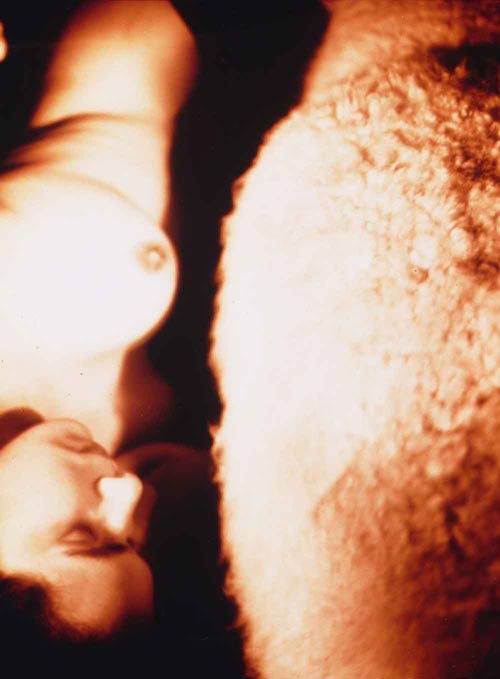
"Pet Thang" (1991) by Tracey Moffatt

"Pet Thang #4" (1991) by Tracey Moffatt, #4 from a series of 6 images, photograph, 110 × 71cm, Edition of 30

Tracey Moffatt (1960) is an Australian artist who primarily uses photography and video. Her work is held in various international private and public collections including MOMA (NYC), Tate Modern (London) and Museum of Contemporary Art (Los Angeles).

Tracey Moffatt first came to prominence in the Australian art world with her series Something More. First exhibited at the Australian Centre for Photography in 1989, the series set the tone and themes of much of her latter work. In a sequence of nine images, Something More is a loose narrative in which the artist puns on the possible meanings of the title and its veiled references to sadomasochism.

Moffatt's photographic series of works such as Pet Thang [1991] and Laudanum [1998] returned to the themes of Something More exploring mixed and sometimes obscure references to issues of sexuality, history, representation and race. Other series of images, notably Scarred for Life [1994] and Scarred for Life II [1999] again tackled these themes but which took the form of book or magazine illustrations with captions offering ironic and humorous commentaries on the images.

(sources: text | photos)

Thursday, September 14, 2006

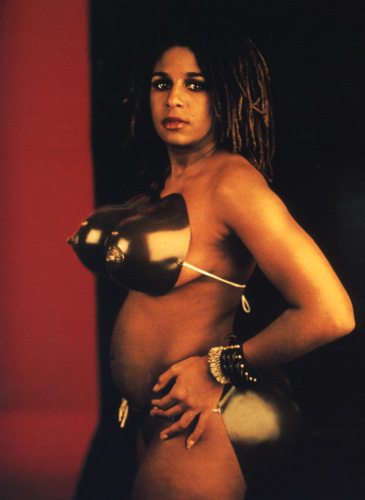
"Venus Hottentot 2000" (1995) by Lyle Ashton Harris

For the exhibition Mirage: Enigmas of Race, Difference and Desire (1995), Lyle Ashton Harris in collaboration with Renee Valerie Cox created the photograph, "Venus Hottentot 2000." In this futuristic reinterpretation of the Hottentot Venus, Renee Valerie Cox directly inserts her own body into the historical matrix of Western representations that configured black female sexuality. In the photograph Cox's body is transformed, recalling the Hottentot Venus, with the addition of protruding metallic breasts and an accompanying metal butt extension. The white strings that delicately hold these metallic body parts in place with bow, seem to emphasize the artists' complex and ambivalent relationships to representations of black female sexuality. Cox wears the metallic appendages like a costume or disguise, but her own nude body is simultaneously revealed to the viewer. She stands in profile emphasizing her bodily dimensions, hands akimbo, and stares directly at the viewer.

Quote from Harris:

This reclaiming of the image of the Hottentot Venus is a way of exploring my own psychic identification with the image at the level of spectacle. I am playing with what it means to be an African diasporic artist producing and selling work in a culture that is by and large narcissistically mired in the debasement and objectification of blackness. And yet, I see my work less as a didactic critique and more as an interrogation of the ambivalence around the body.

source

Buy this book at Amazon.com

Wednesday, September 13, 2006

"Untitled (Girlfriend)" (2000) by Richard Prince

"Untitled (Girlfriend)" (2000) by Richard Prince, Ektacolor photograph, 40x60 inches
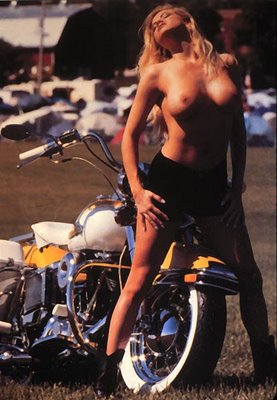
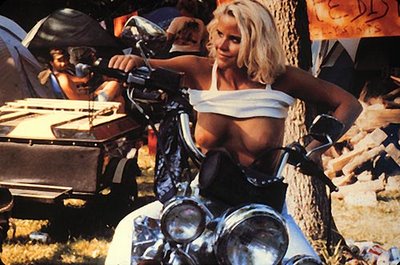
You're excused if you think these are photocopied magazine photos, but please keep in mind that one of Richard Prince's images, "Untitled (Cowboy)", a re-photograph, constructed from cigarette advertisements, was the first "photograph" to raise more than $1 m at auction when sold at Christie's New York in 2005.

Here's what Prince writes about the series these two photos are from at richardprinceart.com:

Practicing Without A License 1977

Rephotography is a technique for stealing (pirating) already existing images, simulating rather than copying them, "managing" rather than quoting them–re-producing their effect and look as naturally as they had been produced when they first appeared. A resemblance more than a reproduction, a rephotograph is essentially an appropriation of what's already real about an existing image and an attempt to add on or additionalize this reality onto something more real, a virtuoso real–a reality that has the chances of looking real, but a reality that doesn't have any chances of being real.

The technique is a physical activity which locates an individual behind a camera, a place from which the individual can view nothing but the collected image, a place that affords the opportunity to view exactly how the audience will eventually see the image as an object and a location from which it is possible for an individual to identify him or herself as much as an audience as an author.

Appropriation 1978

I think appropriation has to do with the inability of the author/artist to like his or her own work. Especially if the work is all theirs. I think it's a lot more satisfying to appropriate, especially if you are attempting to produce work with a certain believability, an official fiction let's say. If you take someone else's work and call it your own, you don't have to ask an audience "to take my word for it". It's not like it started with you and ended up being guessed at. The effect you want to produce is not that different from what an audience sometimes experiences when viewing a good movie. And what's that?

What Cristian Metz called, "a general lowering of wakefulness".

More tits are to be seen in his parties series.

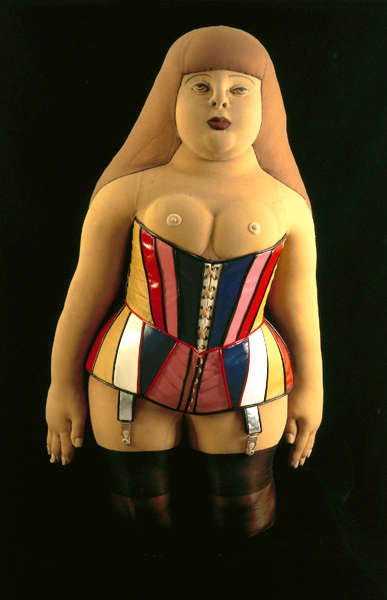
"Lindner Doll" (1965) by Jann Haworth

During the 1960s, Jann Haworth (1942) experimented with a series of cloth work 'celebrity' dolls in which she captured the spirit of the 'swinging sixties' and Pop Art. Alongside Richard Hamilton, David Hockney and her husband Peter Blake, Haworth was a major figure in the first decade of British Pop Art, exploring the imagery of comics, pin-up magazines, consumer advertisements. Two of her cloth work sculptures of this period appear in the foreground of the Beatles' Sgt. Pepper's Lonely Hearts Club Band album cover, a photo-collage which she co-designed with Peter Blake. She explained in an interview with David Lister:

Peter and I were there at the time, talking to Paul and John, and working out what the Pepper cover would be... The old lady and Shirley Temple figure in the foreground were mine, and the idea of going for 3-D figures in a setting was something I was doing at the time. The crowd concept was Peter's. (London, 2000)

The Lindner Doll, clad in her raucous, breast exposing corset, is a play upon the bizarre images of women found in the work of the American Pop Artist Richard Lindner. Jann Haworth continued to work in three dimensional needlework and appliqué throughout the following decade, when she worked with The Brotherhood of Ruralists. Haworth left the Brotherhood around 1980 and returned to the United States, where in Utah, she founded the Sundance Artshack Studio. (source)

It's for sale for £30,000 (56K USD).

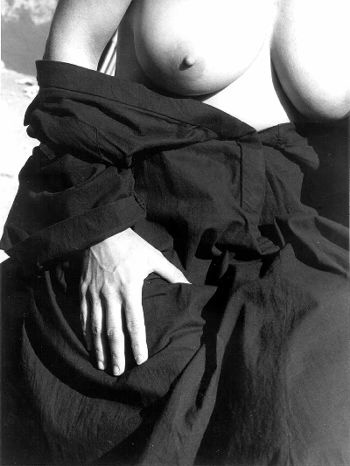
"El Trapo Negro" (1986) by Manuel Alvarez Bravo

Found another one! Accidentally actually. The English title is "The Black Cloth". Also check out the other posts on Manuel Alvarez Bravo.

Sunday, September 10, 2006

"Beach 150" (2005) by Hilo Chen

Hilo Chen (1942, Taiwan) is a Photo-Realist painter. Between 1961 and 1966 he studied Architectural Engineering at Chung Yien College in Taiwan. In 1968 he moved first to Paris, and then to New York City. His work is in the collection of the Guggenheim New York.

Is this fine-art? Here's a quote from Modern Art in the Common Culture by Thomas Crow:

"But the vernacular-based nature of its means of representation (which distinguished it from most Pop painting), meant that it could not remain securely within a fine-art context. Its brief prominence provided a license for certain forms of out-and-out kitsch (the California pin-ups of Hilo Chen, for example), which had the effect of dragging the meaning of the whole practice back into the realm of the uncultivated and naive."

Observations that Chen's work might be a commentary on commercial culture are probably a stretch. His paintings are primarily exercises in technique applied to popular imagery. A painter would question why one would want to paint a photograph. Didn't photography release painting from the drudgery of documentative realism?

Galleries representing his work, and more images, are here and here, and a discussion of his work featuring commenters screaming 'offensive!' and 'porn!' is here.

Read more about contemporary photorealism in this book:
Buy this book at Amazon.com

[via]

Friday, September 08, 2006

"Westminster" (2006) by Erik Sandberg

Erik Sandberg (Quantico, VA, USA), "one of the most brilliant young painters in the Washington area" according to Fraser Gallery, lives and works in Washington, DC. He is a Bachelor of Arts in Studio Arts, George Mason University (1995), a recipient of the Morris Louis Fellowship (1999) and has a Masters in Fine Arts in Painting, George Washington University (2000).

The Washington Post writes that "Sandberg is a gifted young painter whose small, dark oils depict in exquisite detail people in various stages of undress performing a variety of contortions and acts that cannot be mentioned or shown in a family newspaper. Think Hieronymus Bosch meets Madonna at a leather gym. There's nothing easy about these works that seem to depict a multitude of virtues and vices, but it's hard to look away."

You can buy a print of the work above for 45$.

If anyone knows where to find larger versions of these paintings please leave a comment.